
Tamper-evident by design
A change to the content changes the hash—so verification has a clear signal.
Hash it. Anchor it. Verify it.
OwlVerify generates a cryptographic hash, stores proof metadata, and anchors the proof record to the Hedera network—so you can verify later whether content still matches what was originally recorded.
Your underlying file is not stored on-chain.
Prove that what you have now is the same content that was originally recorded—without exposing the file itself on a public ledger.
Built for developers, startups, and teams that need verifiable files, certificates, reports, AI outputs, and digital records
Upload a file or send content through the product or API. OwlVerify prepares a cryptographic hash—a fixed fingerprint of that exact data.
We generate the hash and store the proof metadata needed for verification. The raw document or file content is not written to the ledger.
The hash and proof record are anchored to the Hedera network, giving you an external, timestamped reference you can check independently.
Later, submit content again and compare. A match means it’s unchanged relative to what you recorded. A mismatch means something changed.
Any digital artifact you can hash—broad enough to grow with your product.
Integrity without turning your product into a storage vault or a buzzword factory.
A change to the content changes the hash—so verification has a clear signal.
Proof records sit on a public ledger you didn’t build—useful when you need an independent reference.
Only the hash and related metadata are anchored. Your raw bytes are not the thing being published to Hedera.
Compare new content against the recorded proof in one pass—built for operations, not theater.
Use OwlVerify as a layer inside your platform: issue proofs, run checks, embed integrity into your own flows.
Hedera is a public distributed ledger built for fast, predictable, low-cost transactions. That makes it practical to anchor content hashes and proof metadata as timestamped records—not to speculate on tokens, but to get a durable external reference.
OwlVerify uses Hedera so your proofs can be verified later without trusting only OwlVerify’s servers. The hash and proof record are what get anchored; your underlying file stays off-chain.
Think of it as an independent checkpoint: anyone with permission can confirm that the proof record you anchored still lines up with the content they’re holding.
Concrete ways teams use verifiable proofs—not an exhaustive list.
Issue a credential and anchor its proof. Recipients can verify the file they have still matches what was issued.
Freeze an export or filing as a proof record. Later, confirm the PDF or dataset hasn’t been swapped or edited.
Record a model output at a point in time. Verify whether text or files still match what you originally captured.
Detect silent changes across handoffs, storage moves, or long-lived archives—match or mismatch, plainly.
Pair operational logs with anchored proofs so integrity checks have a clear trail.
Platforms that mint or distribute digital goods can attach proofs so provenance isn’t just a promise in a database row.
OwlVerify is built to sit behind your product: generate hashes and proof records programmatically, retrieve verification metadata, and compare submitted content against what was originally recorded.
/proofs
Submit content or a hash to create a proof record
/verify
Submit content and compare against a stored proof
/proofs/:id
Fetch proof metadata and anchor details
Exact paths and payloads ship with your integration—this is the direction, not a guarantee of every field name.
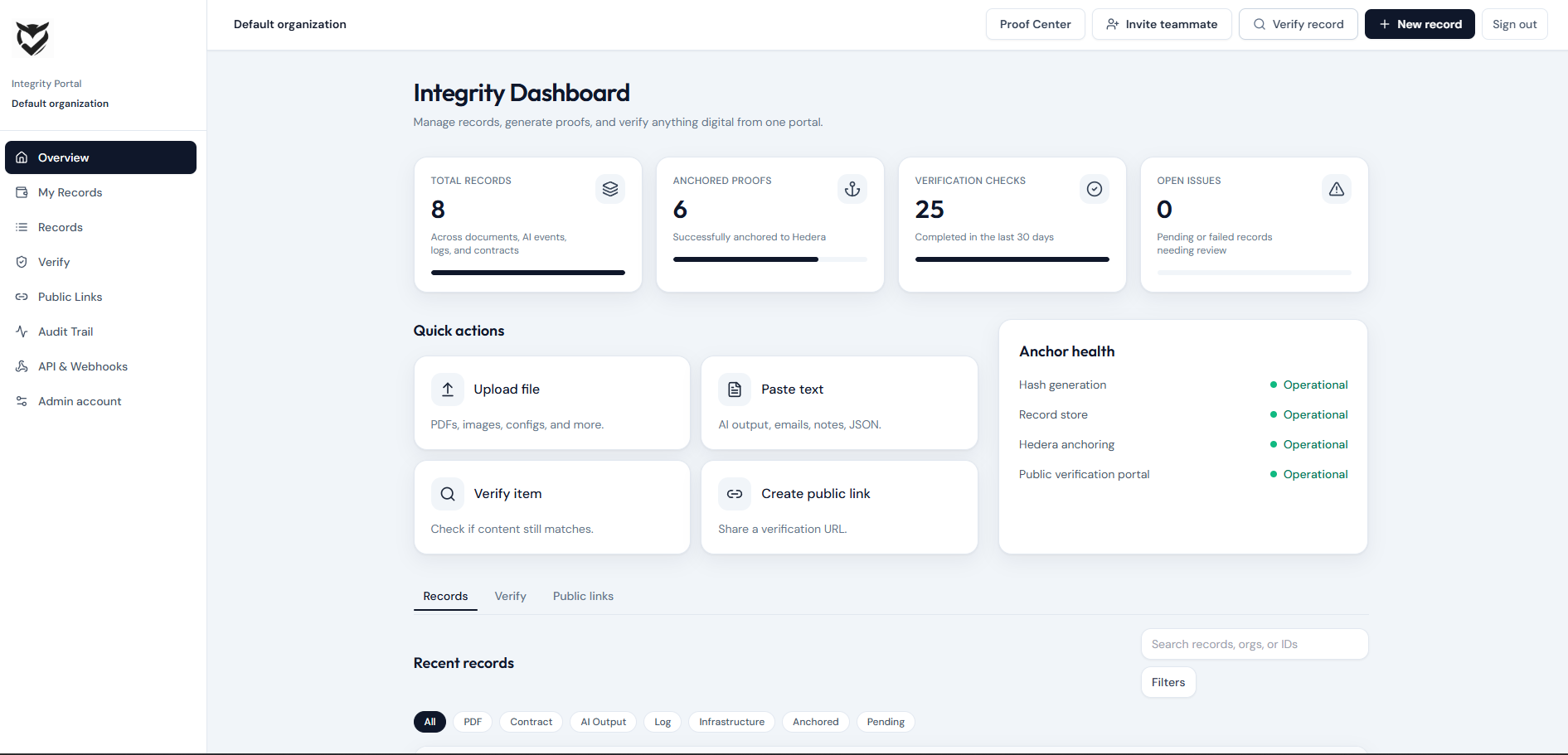
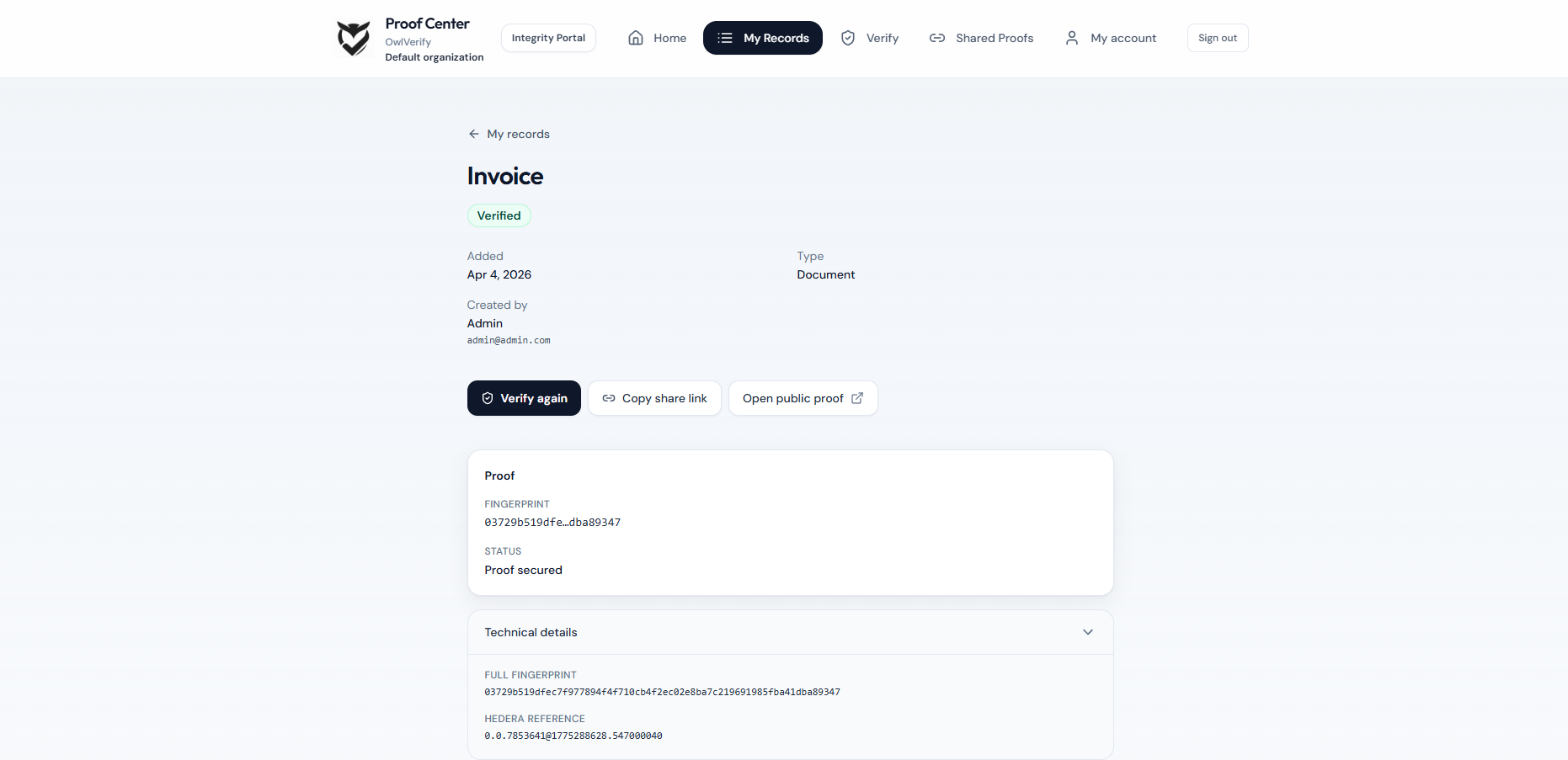
Register proofs, inspect anchor metadata, and run verification from a focused console.
Tell us what you’re building—we’ll align on hash, anchor, and verify flows for your stack.